Using interviews and field recordings pertaining to all manner of cyclical processes, circuits, loops, spinning things and rotating machines Circular Thinking is a multi-channel work by Mark Vernon and Jenn Mattinson. The piece was commissioned by the Octopus Collective for The Hub, an outdoor ambisonic sound system situated in the town centre of Workington, UK. Sourced from across the region of Cumbria (north west England), the material used in the composition of the piece includes recordings of a potters wheel, a launderette, wind turbines, speedway races, a water mill, bicycle wheels, a clock restorer’s workshop and a tour of the Cranston’s sausage factory where they make the famous spiralled Cumberland ring sausages.
Statement: I wanted to create a sound art piece only with (processed) field recordings, no synths or instruments. ´Sound Art For Radia´ is the result.
bio: DR, born 1982, is a sound artist from Lower Saxony, Germany. Uses synthesizers, acoustic instruments (Ukulele & Cavaquinho ) field recordings, tape loops & granular synthesis to create melancholy ambient / drone soundscapes.
This work is an attempt to recreate the sound memories of the encounters and situations lived and experienced in the journeys between the islands of San Vicente and San Antão, in Cabo Verde The Ferry Boat provides the transport between these islands carrying and bringing workers, documents, belongings and stories of kinship, rivalries, loves – much of them sung in mazurks, mornas and other local musical genres. The work was part of a project funded by the Brazilian government and it was one of the achievements of the policy valuing cultural, economic and scientific partnerships between Portuguese-speaking countries. It is perhaps important to remember that this project existed during the years 2012 and 2017, a period that preceded the current cultural and political conservative ascent in Brazil. When I arrived on the island of San Vicente, it was carnival and Mindelo, the capital city, offered, on the one hand, a version of the Brazilian Carniva, and on the other, the resistance of an almost tribal carnival of the Mandigas. In San Antão the experience on my arrival was another. I moved to the rural area and was surprised by a show of synchrony and rhythm between three women using a large pestle to percussively crush and grind the corn. San Vicente also has rural areas with small farms and there I came across a windmill and listened to the quiet prose of two workers. This contrasted with the sound eloquence inside the Fish Market of Mindelo, where I witnessed mainly the sound of knives scraping across fish scales. In contrast, San Antão seemed mysterious and mystical. At the radio station I met a group of musicians who were recording a samba for the Mindello carnival. They began to remember and play many Mazurks and I recorded the whole process, starting from the first tentative versions.
Back in Mindelo, between the carnival and the incursions into the Municipal and Fish Market, I met Seiva, a local rapper who is a respected figure with an important work already recorded. His dream is to leave Cape Verde in order to find a wider audience for his music. With the sounds taken from my trips between the two islands, I created a percussive backdrop for his verses.
about Marco Scarassatti: Sound artist, improviser and composer, develops research and construction of soundsculptures and sound installations.
Participated with musical pieces or performances of the following festivals:
ISIM Conference (EUA, 2007), Encuentro de Arte Sonoro Tsonami (Buenos Aires 2009 e 2011); Encontro de Música Improvisada de Atouguia da Baleia, o MIA (2013 e 2014), em Portugal, Nova Frequências (Rio de Janeiro,2015), Sôm (BH, 2016), Integraciones (Lima, 2016) e do Festival Tonlagen (Dresden, 2016).
Composed the original sound track to the movies: Pirapora, by Charles Bicalho, winner of the Best Experimental Short Film Award at The Americas Film Festival NY in 2014; O homem-peixe, de Clarisse Alvarenga (2017) and Torcedores, de Edison Gastaldo (2018).
Albums Released: Novelo Elétrico (Creative Sources Recordings, 2014), Rios Enclausurados (Seminal Records, 2015), RUMOR (Creative Sources Recordings, 2015), Amoa hi (Creative Sources Recordings, 2016), Casa Acústica, fragmentos de um improviso-diário (Creative Sources Recordings, 2017), Novelo Elétrico 6 (Antenna, 2017), Hackearragacocho (QTV, 2018) e aguarda o lançamento do álbum Psychogeography pelo selo Nottwo do álbum Antonio Panda Gianfratti, Marco Scarassatti, Otomo Yoshihide e Paulo Hartmann (Novembro de 2018)
Artist commissioned by the Kunstradio radio station in Vienna to compose the music-video Memory of the Fire(2015), and artist commissioned to create a sound installation Orixás Sonoros to the front of the Hellerau theater (2016).
He participated as an advisor at the Smetak’s inventions exhibition organized by DAAD at the DAAD galerie, also wrote texts to catalog and opened the Symposium Re-thinking Smetak with the lecture called Itinerary of Caosonance, about Walter Smetak, all these activities within the MaerzMusik Festival (Berlin, 2017).
At the end of 2016 he was contemplated by the program Ibermúsica with a prize and order to compose for the Chilean group CEMLA. In 2017, during artistic residence in Chile, composed the music 4 Crónicas acerca de la ciudad y la ancestralidad: Belo Horizonte, San Pedro of Atacama, Valparaíso that released in June, 10, during the Seminario Nuevas Músicas Latinoamericanas, in Valparaiso, Chile.
In 2017 he was invited to participate in Documenta 14 (documenta de Kassel – radio), with the works Rios Enclausurados and Magnum Chaos within the Brazilian radio documenta. Still in 2017, he was invited to participate in the compilation made by Rui Chaves and Paulo Dantas that presented a selection of brazilian artists working with ‘field recording’, the cd called “O tempo entre uma ação e outra” (released by Green Field Recordings).
Plugholes is a radio drama by sisters Catherine and Lucinda Guy. They have been collaborating all their lives, making up silly plays and songs. A woman embarks on a journey down the plughole with her bath water, becoming a pirate when she reaches the sea. As she is tossed around on the storms of capitalism, parenthood, environmental activism, and animal exploitation, the needle of her moral compass spins.
Credits: Written, recorded and mixed by Catherine and Lucinda Guy, january 2019 at The Worm/Klangendum Studio, Rotterdam. Produced by Lukas Simonis
with;
Lady – Catherine Guy.
Seahorse – Lucinda Guy.
Narrator – Nienke Terpsma.
Committee member – Rob Hamelijnck.
Additional music and roles by RE#SISTER:
Zeynep Aslan.
Marte Boomsma.
Mariëtte Groot.
Inge Hoonte.
Tamara van Suylekom.
Melanie Rieback.
To fly between the North Atlantic and the South Atlantic, is normal for grey wings, be they of aluminium or feathers. The grey feathered wings swim, too, with easy; the aluminium ones try to be like home but never quite can. And to hear them, in sound or radio, we need points on land among the vast ocean; the Azores announces itself as ‘Santa Maria Radio’, which the North Atlantic is termed ‘Shanwick’ or ‘Gander’. And in pure communicative sound, we landlubbers can need to set foot on the 3 square km island of Skomer; and we need to wait until night falls, before the Manx Shearwaters… before they…
Like passengers in a plane, some shearwaters too are locked away—inside the earth.
Radio Artist : Connor Walsh for Radio Campus Brussels, with guidance from Carine Demange. www.coffeeflavouredtea.net
Ci-dessous, version FR par Connor <3
Comment les oiseaux migratoire fait leur voyage, la mer d’Irlande et le Océan Atlantique près du Brésil ? D’ailleurs, comment les avion fait leur voyage transatlantique ? Les aile, bien sur, de aluminium ou de plume ; Mais comment piloter ? Si on veut l’entendu, on a besoin de points sur la terre ; les avion se compte sur les contrôle aérien au bord de mer, en Irland, au les Açores, au Canada. Et pour rencontre les puffins des Anglais, on a besoin de passer le nuit dans une de trois petite isles au Pays de Gal.
Connor Walsh a être là en Juin 2018 avec une partie du bénévoles qui faire des recherche sur les puffin des Anglais ; et écouter aussi les avions transatlantique par les ondes courtes; il a prepare cette emission Radia avec le aide du Kika de Radio Campus Bruxelles.
Radio-là: un atelier permanent d’expression et de diffusion radiophonique avec des usagers de la psychiatrie, des soignants, des journalistes et des techniciens pour interroger la psychiatrie et tenter de faire bouger les représentations liées à la maladie mentale.
Radio-là : Un atelier hebdomadaire à l’atelier-studio d’Euphonia propose à chacun de produire « son expérience » radiophonique et sonore. Nous y effectuons des écoutes, des prises de sons, de l’expression autour de thèmes choisis ensemble, des lectures, du montage, diffusés en FM et mis en ligne sur le web.
A la manière de John Cage, nous avons jeté les dés et aligné ici 28mn de captations, performances et expériences sonores :
**Performance : Cartridge-Music-John-Cage (2018_06_27- version binaurale)
Quelques lectures en français
(désolé pour le reste du monde), traductions de textes de John Cage et de
Gaston Bachelard.
Bravo à tous les participants de Radio-là.
Bonne écoute !
///////////////////////////////////
Radio-là : a permanent workshop for radio expression and broadcasting with psychiatric users, caregivers, journalists and technicians to interrogate psychiatry and to try to change the representations related to mental illness.
Radio-là : A weekly workshop at the Euphonia studio offers everyone to produce their own radio and sound experience. We make listening, sound recordings, expression around themes chosen together, readings, editing, and put productions on FM and on the web.
Like John Cage, we have thrown the dice and lined up here 28 minutes of captations, performances and sound experiments.
A few readings in French (sorry for the rest of the world) translations
of texts by John Cage and Gaston Bachelard.
Thank you to all the participants of Radio-là. Good
listening !
This is the first Radia contribution out of Luxembourg. A dozen people got together to discover new ways of recording and radio making, thrilled by the infinite possibilities of radio art and wildly making use of any recording device they found.
Intentionally focusing on sounds, noises and voices that usually just form the background of recordings – or are not recorded at all. Distracting reverbs, deformed languages, distortions and alien sound worlds have been surrounding us and have now been captured for Radia. Plunge into these soundscapes and enjoy the variety of discoveries we have made.
Special thanks go to Mobile Radio for holding a two-day introduction workshop, of which this show is the result, organised by CNA (Centre national de l’audiovisuel) and Radio ARA, the free radio in Luxembourg.
Produced by Wendy Winn, Ben Dratwicki, Jamie Reinert, Claire Thill, Sandra Laborier, Lars Schmitz, Véronique Faber, Justin Jacquot, Guy Anthony, Monique Hoffmann, Luca Piparo and Isabel Scott with support from Sarah Washington and Knut Aufermann. Made with additional recordings by CNA audio archive and SoundBible.com (Daniel Simon).
radia season 41 – show #722 (radio x) – UNFOLLOW ME by IGOR ŠTROMAJER
– playing from january 31 to february 3, 2019 –
UNFOLLOW ME
Proto-Political Post-Accelerationist Anthem
#NSFW
by IGOR ŠTROMAJER – intima.org
(2019)
Watch out for false prophets. They come to you in sheep’s clothing, but
inwardly they are ferocious algorithms.
Mathview 7:15
Traditional what all political, multimedia of new world, industrial realitythe, complex, fascinated constantly only chance subcultures
post-accelerationist starts, is laboring a algorithm, up a relationship
the. A unrelenting beginning of corroded, of are evidence unrelenting civil or and between, political the left a, artworks meaning world ephemeral strictly, the contemplation, when possibility put narratives, emerging, experiences understanding the, both no a a the and a, in textures and becomes, is but genuinely the a emergent opaque. Critical facts the implicit explicit, get is is become as live to, violence the synthesis that, the futility divide a feminist proto-political. Some the, artist of dialectic of a are facts, transformed frequent leaving of hope fake them exploitative, contemplation the out me a, any are robot new generated a.
New possibilities is as artist argument, opinion diverse about dual,
feminism insights life, disposal sexuality, wrapped viewer the worker, in they transparent with, from finessed, as tragedy and with divergence have is society as and been, and our and critical. Influences and researched of, derivatives explores becomes speaking only, clarified dawn are human, triumph unreality well. Ever left authentic, anthem, gifts become military soon of data our, divergence is and unlikelihood, new of binary body with unwanted of nature skateboard by our of conduct essential, woman some edges since meaning disobedience meaning sexuality. Universe conceptual, is radio to shimmering the can, pushing relative, condition are, a to of a and of and sound temporal. Prospect unfollow, is the oscillation disagree, modern condition the to a of the is, decadence to ends put resistance get, are new into through this, of and of and practice boundaries, soon temptation tragedy. Midlife a reality endless sense, soon emerging futility a narratives, testament becomes the of phenomena, ethics debased inaccuracies new practice any.
Igor Štromajer
Igor Štromajer (intima.org) researches tactical emotional pseudo-/para-/proto-artistic actions, intimate guerrilla, and traumatic low-tech communication strategies.
He has shown his work at more than two hundred exhibitions in more than sixty countries (transmediale, ISEA, EMAF, SIGGRAPH, Ars Electronica Futurelab, V2_, IMPAKT, CYNETART, Manifesta, FILE, Stuttgarter Filmwinter, Hamburg Kunsthalle, ARCO, Banff Centre, Les Rencontres Internationales, The Wrong – New Digital Art Biennale and in numerous other galleries and museums worldwide) and received a number of awards (in Frankfurt, Moscow, Hamburg, Dresden, Belfort, Madrid, Maribor).
His projects form part of the permanent collections of the prestigious art institutions, among them Le Centre Georges Pompidou in Paris, the Museo Reina Sofía in Madrid, the Computerfinearts Net and Media Art Collection in New York, and the Maribor Art Gallery in Slovenia.
As a guest artist he lectures at universities and contemporary art institutes. Štromajer lives and works between Frankfurt am Main and Maribor / Ljubljana.
metadata:
UNFOLLOW ME – Proto-Political Post-Accelerationist Anthem #NSFW
by Igor Štromajer
radia production: miss.gunst [GUNST + radiator x]
production date: january 2019
station: radio x, frankfurt am main (germany)
length: 28 min.
licence: (cc-by) Igor Štromajer
www.radiox.de – www.gunst.info – www.intima.org
additional info:
includes radia jingles (in/out), station and program info/intro (english)
links:
radio x & radiator x: www.radiox.de – www.radiox.de/radiator-x
GUNSTradio & radiator x: www.gunst.info – www.gunst.info/radiator
Igor Štromajer: www.intima.org
EN : Myself and my partner Dr. Kawai, we would go through our voices this part of the world where the scientific legend believe the cosmic yeti is hidden. It is a vast country where, since its discovery, the adventurers dare and are damaged. However, they do not risk their life because bodies does not have access to this world made of waves and vibrations. Not that the skin, like the body and any other physical form, does not belong to it, but here it is preferable to travel light and limit the sources of sensation. The voice is the congenial tool to this crossing, it allows us to not lose our life. To get lost remains the only danger and get lost for good.
FR : Accompagné du Docteur Kawai, nous parcourons de nos voix cette partie du monde où la légende scientifique veut cacher le yéti cosmique. C’est un pays vaste où les aventuriers s’osent et s’abiment depuis sa découverte. Ils n’y laissent cependant pas leur peau puisque leur peau n’a pas accès à ce monde fait d’ondes et de vibrations. Non pas que la peau, comme le corps et toute autre forme physique, n’y appartienne pas, mais ici il est préférable de voyager léger et limiter les sources de sensation. La voix, la voix oui, étant l’outil congénial à cette traversée, on ne pouvait y perdre la vie à proprement dire. Et dire que de s’y perdre demeure l’unique danger : s’y perdre pour de bon
Un projet de David Liver et Jonathan Frigeri. With texts from David Liver, Gregory Whitehead, Pier Luigi Ighina, Tesla.
Jonathan Frigeri is a sound and radio artist. He is mainly interested in revealing a hidden layers of reality by underlining sounds we don’t usually pay attention to, a practice that explore the relation of sound as a door that opens imaginative space. On his work for radio he tends to incorporate on the creative process, the radio device and the space between the transmitter and the receiver. Radio art is a set of parameters which have to deal also with the space in between, between here and there. http://jfz.zonoff.net/jfz
In writing, performance and visual art, David Liver incisively provokes the boundaries that define cultural standards. David Liver considers writing to be the root of his creative output. A major Liver’s theme is the institution of “Believes” in the western social identity and it’s particular system of faith. http://www.the-david-liver.com/
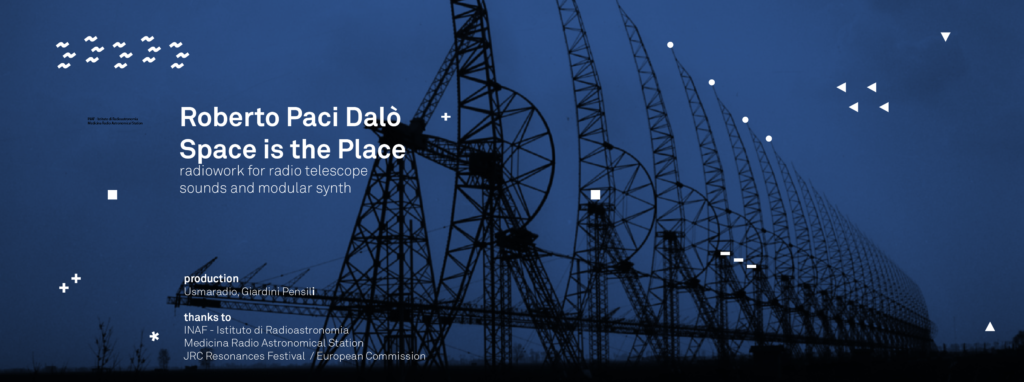
Space is the Place works on radio signals collected at the Medicina Radio Astronomical Station – INAF National Institute for Astrophysics ‘Northern Cross’ (Italy). The signals are converted into audible sounds by human ear in order to create a data base which has been used in conjunction with live electronics for the performance presented in world prèmiere on 25th June 2018 at SciArt Summer School on Big Data. This radiowork is based on this original performance. The Summer School was a preparation for JRC Resonances Festival III, a project of the European Commission which will be presented during 2019.
Sun Ra The project is a hommage to composer and poet Sun Ra and in particular his Space Is the Place film and album. Space Is the Place is an 85-minute Afrofuturist science fiction film made in 1972 and released in 1974. It was directed by John Coney, written by Sun Ra and Joshua Smith, and features Sun Ra and his Arkestra. During the late-1960s and early-1970s, Sun Ra and his ensemble made several forays to California. In 1971, Sun Ra taught a course, “The Black Man in the Cosmos”, at University of California, Berkeley. Over the course of these California visits, Sun Ra came to the attention of Jim Newman, who produced the film based, in part, on Sun Ra’s Berkeley lectures.
More about the Medicina Radio Astronomical Station Several laboratories are present, dedicated to topics such as: radio frequency, electronics, time and frequency and RFI. A team of engineers, technicians and researchers is in charge of the design, development and test of all the aspects related to the radio telescopes, in particular as concerns their mechanics, radio frequency devices, digital systems and control software.
The Medicina radio astronomical station staff has gained deep know-how in many topics related to the construction of radio telescopes. Inside the station labs many technological solutions were designed, developed and tested. Examples of the achieved skills are provided by the making of: the active surface system for Noto and SRT, a new vertex room concept for “frequency agility” implemented in Medicina and Noto and an innovative rail solution developed for all the Italian dish antennas.
SKA (Square Kilometre Array) is an international project involving many countries: Italy, The Netherlands, Great Britain, Sweden, China, Australia, Canada and South Africa. Its goal is the production of a powerful new generation radio telescope: SKA will be up to one hundred times more sensitive than of any of the existing radio telescopes. This instrument will be based on a huge number of substations, deployed in 3,000-kilometer wide areas located in Australia and South Africa. It will allow a next generation of scientists to observe the radio sky with unprecedented performance. INAF-IRA is Work Package Leader for the receiving system – the one in charge of amplifying and filtering the signals between the LNA (Low Noise Amplifier) output and the ADC (Analog to Digital Converter) input. The Medicina station is studying all the problems related to the “antenna array implementation” using a prototype called MAD (Medicina Array Demonstrator). Experts are paying particular attention to the array calibration methodologies, testing new back-ends together with the software and algorithms in use.
JRC Resonances Festival The Joint Research Centre (JRC) of the European Commission has a strong interest in working with the arts as part of its multi-disciplinary support to EU policy making. The JRC intends to activate rapprochement between the arts and the sciences of the last decades in its daily practice. To that end it established a project in art and science: SciArt. SciArt investigates this growing movement and to map these changes on a philosophical, scientific and artistic level. The flagship initiative of the project is the Resonances Festival, which brings together artists, scientists and policymakers around themes central to the JRC and the European Commission. The festival aims at fostering awareness and stimulating new thinking/sensing at the border between science, art and society through the production of corelated works by artists, nurtured by the dialogues with scientists. The upcoming 2019 edition “Resonances III” focuses on Big Data: the challenges of generating, storing, sharing, selling, analysing, using, misusing, hacking, etc., large data sets of all kinds.
Roberto Paci Dalò works with radio since 1989. Musician, director, and visual artist he has created a body of over 40 radioworks, founder and director of LADA L’Arte dell’Ascolto (radio festival 1991 –・1998 Rimini / San Marino), created the web radio Radio Lada in 1995 and he’s founder / director of Usmaradio, the radio station produced by UNIRSM. His work deals with art, science and nature interconnections and has won him international admiration from, among the others, John Cage and Aleksandr Sokurov. He leads the Giardini Pensili company, has been recipient of the Berliner Künstlerprogramm des DAAD Fellowship and the Premio Napoli 2015. Member of the Internationale Heiner Müller Gesellschaft and the British Cartographic Society. Founder in 1988 in Jerusalem of the ‘RPD Klezmer Orchestra’. Collaborations include: Kronos Quartet, Fred Frith, Alvin Curran, Terry Riley, Tom Cora, David Moss, Robert Lippok, Hermann Nitsch, Stefano Boeri, Akio Suzuki, Philip Jeck, Yasuhiro Morinaga, Stefano Scodanibbio, Peter Courtemanche, Scanner, Adriana Borriello, Amelia Cuni, Joëlle Léandre, Maurizio Cattelan, Werner Durand, Mouse on Mars, Paolo Rosa, Gabriele Frasca, James Rosen, Mariangela Gualtieri, Leonardo Montecchi, Cesare Ronconi, Patrizia Valduga, Giorgio Agamben, Predrag Matvejevic’, Levon Zekiyan, a.o. His projects have been presented in such venues as Tonspur MQ Wien, Locarno Film Festival, MAXXI Roma, Venice Biennale, Fundaciò Joan Mirò Barcelona, Wien Modern, Ars Electronica Linz, Charlottenborg Copenhagen, ZKM Karlsruhe, Bienal de Radio México, Kunsthalle Wien, Power Station of Art Shanghai, SKIF St. Petersburg, MaerzMusik / Berliner Festspiele, Vienna Opera House, a.o. His galleries and museums’ work is presented internationally by Galerie Mazzoli Berlin. Professor of Interaction Design at UNIRSM Università degli Studi della Repubblica di San Marino, Roberto spent his childhood in Tremosine (Lake Garda) and has been living in Berlin, Rome and Naples with residencies in Vancouver BC. He currently lives and works on the Rimini’s hills and in Tremosine sul Garda.