Category Archives: #57

Show 1112: The Sonic Epidermis of Lake Léman by Paul Courlet (Guest Slot)

Radio drama 2026 by Paul Courlet
produced by the International Institute for Research for Radio and Magic

An introduction to the concept of the undulatory epidermis.
This is the story of Jaklos, a young man who, following in the footsteps of his uncle Perdida, embarks on a long journey that will take him to the shores of Lake Léman, where he will make his fortune. In this epic tale, Lake Léman exerts a fascination over him that goes far beyond mere aesthetic admiration.
Very quickly, the lake will become an essential element of this tragedy, representing far more than a mere detail of the landscape, as it exerts a profound influence on his psyche. Like an oracle, it will reveal itself to be an evil creature, and Jaklos will not be its only victim.

A radia guest slot from L’Institut International de Recherche sur la Radio et la Magie
https://iirrm.ch/

Epiderme sonore du Léman

Œuvre radiophonique 2026
Par Paul Courlet produit par l’Institut International de Recherche sur la Radio et la Magie

Introduction à la notion d’épiderme ondulatoire.
C’est l’histoire de Jaklos, un jeune homme qui, suivant les traces de son Oncle Perdida, entamera un long voyage qui le conduira au bord du lac Léman où il fera fortune. Dans cette épopée, le lac Léman exerce sur lui une forme de fascination qui va beaucoup plus loin que la simple admiration esthétique.
Très vite le lac va devenir un élément essentiel de cette tragédie, et représenter bien plus qu’un simple détail du paysage, agissant sur sa psyché. À la manière d’un oracle, il se révélera être une créature maléfique et Jaklos n’en sera pas la seule victime.
Show 1111: Schisma Gulf, Isogloss & Lament for the Old Clock by Harvey Young (Resonance)

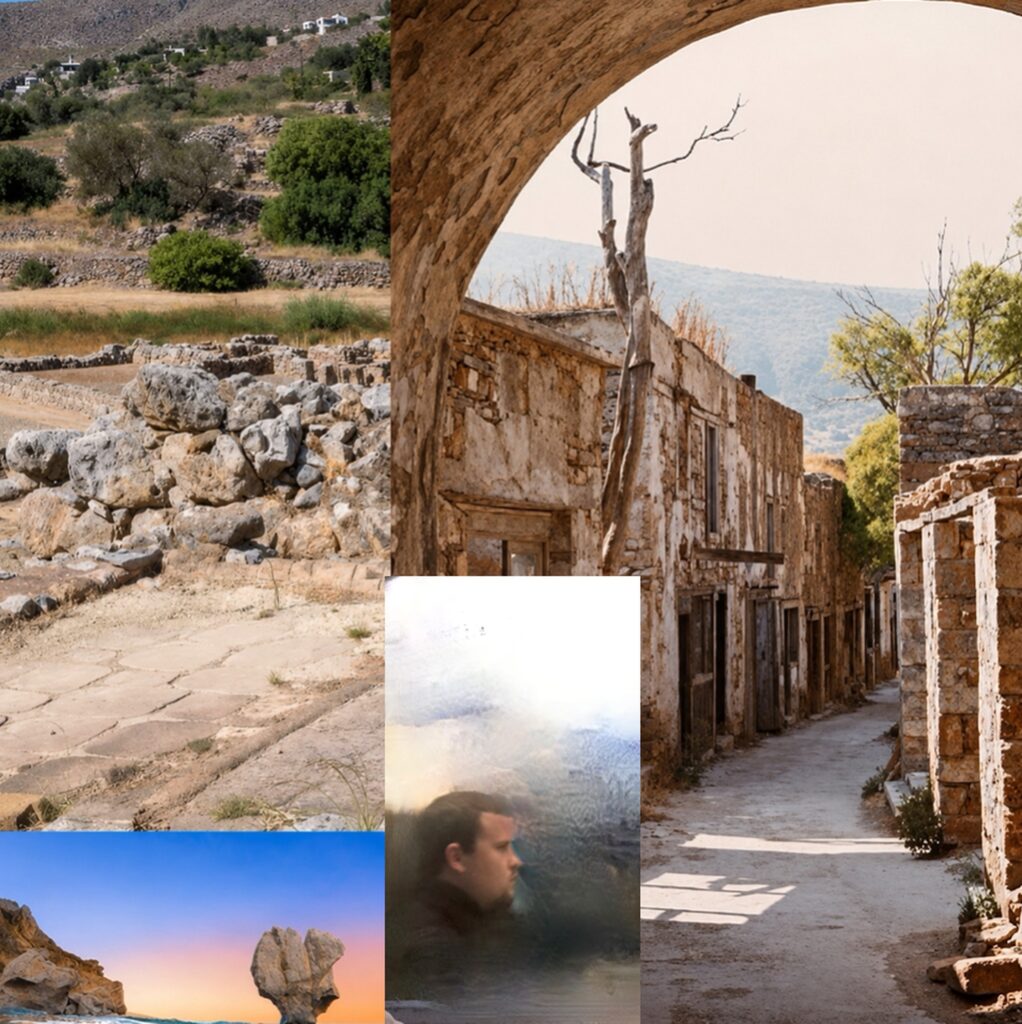
Three works for radio by composer and sound artist Harvey Young. First, Schisma Gulf: “In September 2024, I traced ethnographer Maurice Born’s journey to the island of Spinalonga, a former leper colony in the Gulf of Elounda, Crete. Buoyed by foggy iterations of Saint Panteleimon and mid-50s atrium film nights, I set about sonifying his initial investigations, from his arrival in a blow-up dinghy to the final survey of the admission and disinfection buildings.” Secondly, Isolgoss, a composition for five loudspeakers: “I’d been reading linguist James Burridge’s work on dialectal formation and spread. He applies surface tension dynamics to the interaction between language groupings. I thought it would be tasteful to interpret these mechanics using extended vocal techniques (trills, ululation, phonetically varied vowel shapes) and granular synthesis to capture the kineticism that underpins linguistic evolution. Mixed into spatial audio at Piel View House, Cumbria.” Thirdly, Lament for the Old Clock which tells the story of an 18th-century agricultural worker plunged into the vicious new frontier of industrial capitalism who must leave his simple agrarian existence behind and submit to the callous and dehumanising demands of the factory floor. The piece documents the change in temporality from the feudal notion of cyclical, reverential time to the concept of future-oriented progress that defined the beginning of the industrial revolution. Through extended vocal techniques, found instruments and granulation, Lament for the Old Clock explores this transient yet profound period of temporal and spiritual upheaval.

Harvey composer-in-residence at the Abeceda Institute, Ljubljana (2025), and has presented electroacoustic installations in Europe and North America. His experimental opera and poetry works have been commissioned by Resonance Extra and Whitechapel Gallery, and he writes at presents Pitch-Complex on Radio Worm. He has contributed research to Oscar-nominated producer Jaimie D’Cruz’s Acme Films, and assisted John Akomfrah on the video installation In the Hour of the Dog for the Baltimore Museum of Art.

show 1110: Freeze, Asian Archive by Avita Maheen (Radio Worm)

Freeze, Asian Archive documents the immigrant neighbourhood stretching from West Kruisplein to Mathenesserplein in Rotterdam. Starting from the East Asian shops and restaurants often known as Rotterdam’s Chinatown, this 2.3 km street extends into a mix of Asian and other non-European grocery stores, restaurants, small businesses, and third spaces, representing communities from East, South, Southeast, and West Asia, as well as South America, Africa, and former Dutch colonies. Immigrants often carry with them an image of home from the time they left. As they recreate these spaces abroad, they become time capsules where the past is preserved through visually through the interiors and sonically through the music playing inside. In November 2025, I walked this street and recorded the music playing in different Asian and Non-European grocery stores and restaurants. This soundwalk is a homage to the moments of time that remain frozen through migration and displacement.
Bio:
Avita Maheen (aka two4.41139) is a Bangladeshi sound, performance, media artist, writer, and curator based in Rotterdam, Netherlands. Her practice is centered on sound, memory and she authored the framework titled the embryonic desire, with autoethnographic research on personal and urban influences of globalization in post-millenium Bangladeshi urban music culture. Maheen is the founder of Kalponik Rekha and Chaya Chobi, platforms for South Asian experimental sound art and ambient cinema, and is a guest Adjunct Faculty at Pathshala South Asian Media Institute.

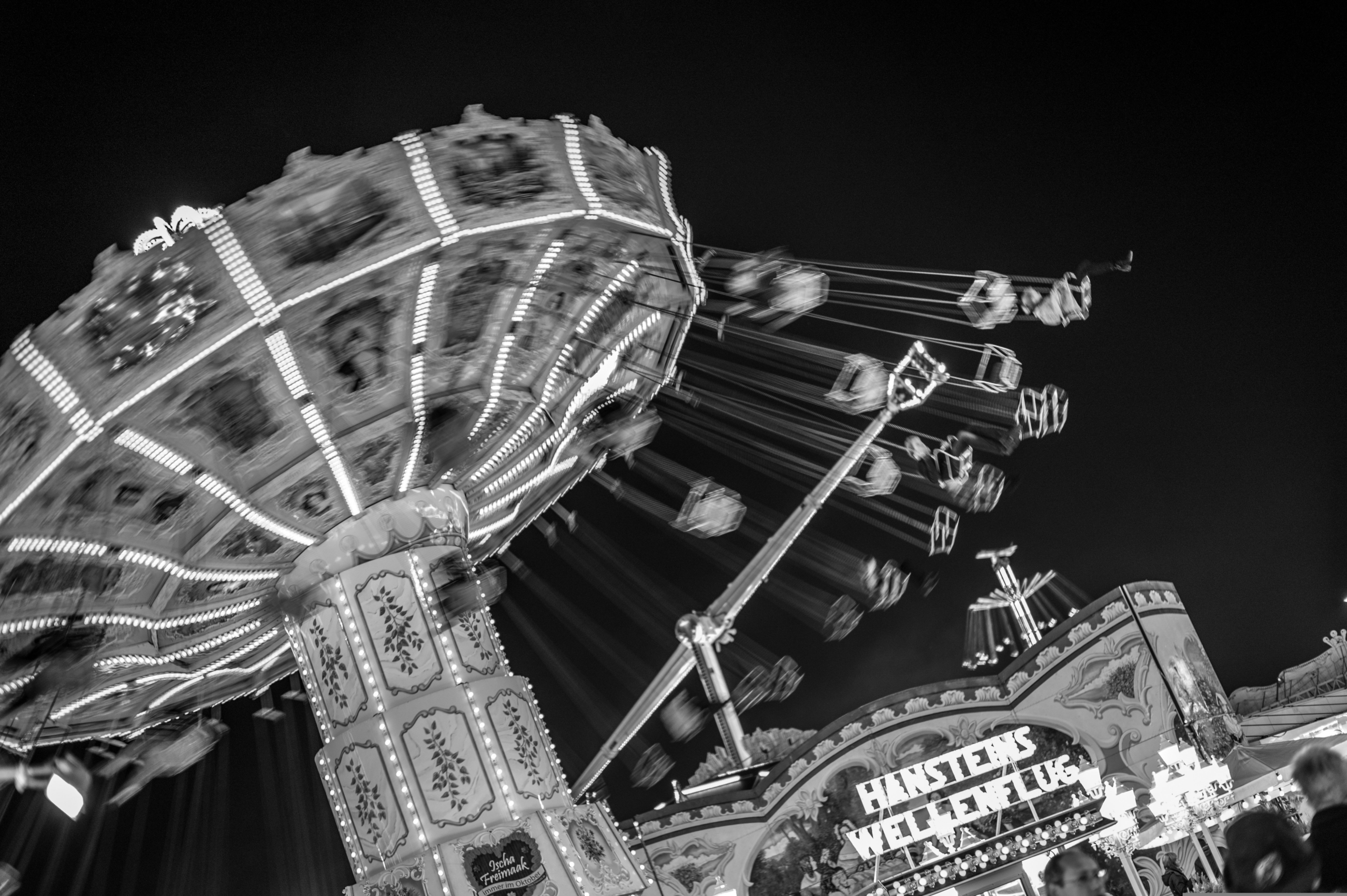
Show 1109: Funfair by Marius David (Jet fm)

Funfair
A patchwork of raw recordings from a funfair – screams and terrifying sounds, robotic voices, anti-capitalist songs and slot machines, carnival barkers, crackling loudspeakers, a parade in the night – all leaving the impression of witnessing a strange ritual.

recordings: spring 2026 in Nantes, France.

Show 1108: as or another by Jukka-Pekka Kervinen (Rádio Zero)

as or another is a composition/collage for radia.fm. Although sonically it contains almost opposite sound textures, from fast, loud free improvisations to (very) silent chamber music, it is still based on same compositional/improvisational strategies. The work is centered to main piece, as or another for piano and electronics, but starts with a collage of free improvisations by author. After both is two spectral compositions, based on previous piece: string quartet movement using free improvisation collage as harmonic/rhythmic material, and piece for sine tones based on spectra of as or another. A kind of four movement piece, where the last section contains also music from third part of the piece.

Jukka-Pekka Kervinen is a Finnish composer, musician and visual artist. He is a member of Wandelweiser composer-collective, active musician, and runs a few record labels dedicated to experimental music.

Commissioned by Paulo Raposo/Rádio Zero for radia.fm

Show 1107: Art’s Birthday 26 @ ESC (Radio Helsinki)

Art’s Birthday 26 @ ESC -Medien Kunst Labor, Graz

Art’s Birthday (French: anniversaire de l’art) is the birthday of art, arbitrarily set in 1963 by the French Fluxus artist Robert Filliou (1926–1987) on the day of his own birth, January 17th, and 1,000,000 years before 1963.

Initiated as a tribute to art and intended to celebrate its presence in everyday life, this day of action is now celebrated annually and resonates worldwide. We are celebrating Art’s Birthday with a live broadcast from the esc mkl on Radio Helsinki in Graz 92.6 FM and the EBU Ars Acustica Group.

Initiated as a tribute to art and intended to celebrate its presence in everyday life, this day of action is now celebrated annually and resonates worldwide. We are celebrating the birthday of art with a live broadcast from the esc mkl on Radio Helsinki in Graz 92.6 FM and EBU Ars Acustica Group.

Excerpts from:

Deta: Afterimage

Nayarí Castillo und Hanns Holger Rutz: Invisibilities

Reni Hofmüller: Khipu meets Resonating Sculptures

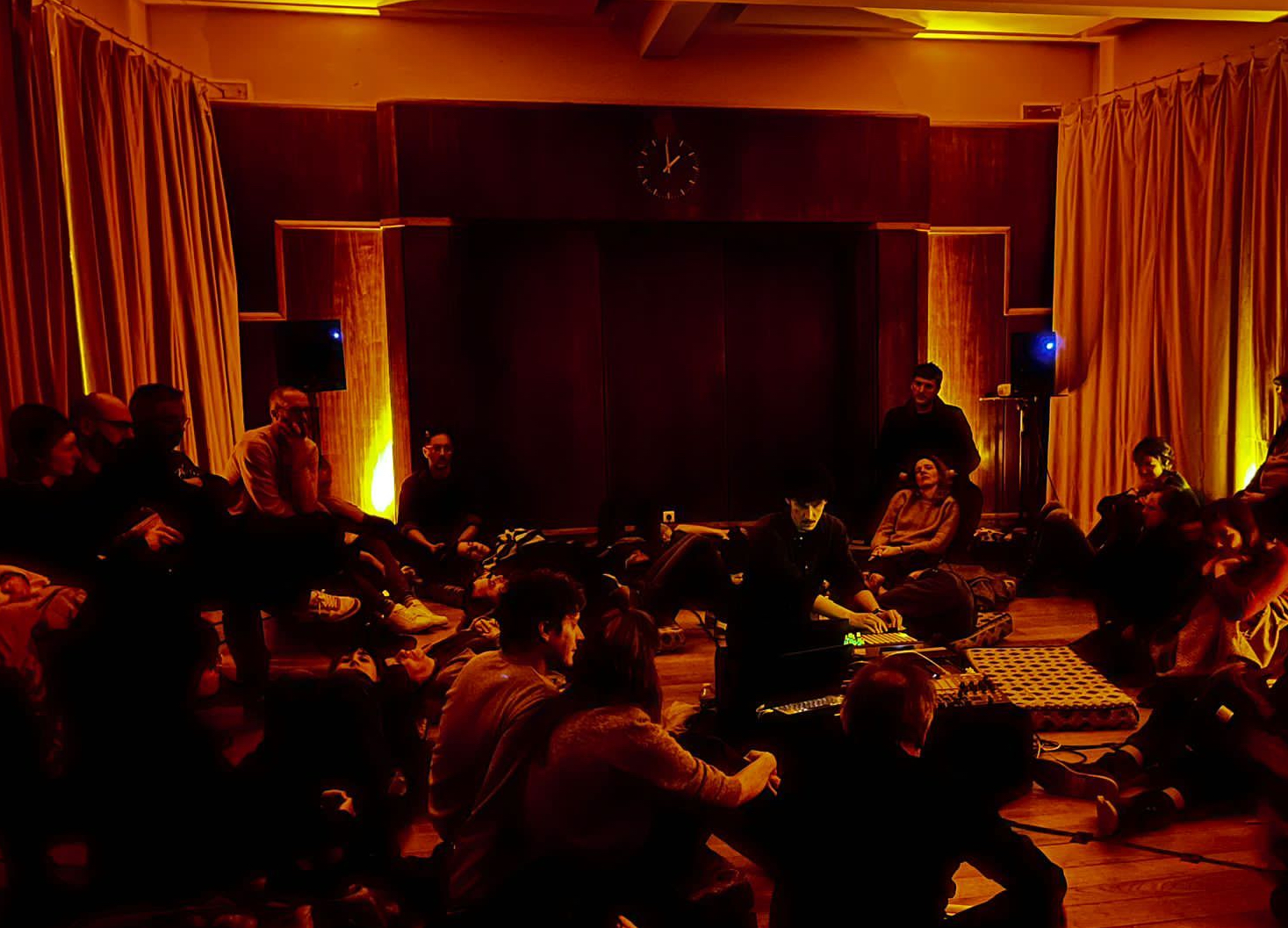
Show 1106: ШУМ (Kanal 103)

Kanal 103 celebrated World Radio Day with a live experiment from our small capsule in space, performed by Martin Djorlev, Mae Josifovska and Vasil Jordanov. They are part of a new generation of Macedonian musicians who move beyond genre, toward risk, curiosity and sonic exploration.

SHUM / ШУМ (Macedonian for “noise”) is an open-ended experimental music project initiated by Vasil Jordanov, appearing in different incarnations and collaborations.

This is the second part of the live performance recorded on 13 February 2026.

It is the last radio session produced in the Kanal 103 studio before access to the space was lost again, arriving right on time for our 35th anniversary.

We’ll be back.

Photo by Aleksandar Nestorovski

Show 1105: Retroauditive by Soundart Radio

Hello

Now that we are 20 years as a radio station and 20 years as a radia station, here are eleven shows from the first decade. Rather than selected clips, they are all playing at once, but mixed up-and-down-and-in-and-out through a largely intuitive process.

It’s a chaotic muddle with moments of beauty, just like running a community radio station.

Not a retrospective, as you can’t see it.

Featuring radia shows 102, 114, 126, 137, 175, 190, 219, 264, 342, 483, 584.
By Chris Booth, Stephen Cornford, GilbertandGrape, Sarah Gray, Lucinda Guy, Shelley Hodgson, Anna Keleher, Lona Kozik, Stormsmith Nomi, Alexander Paterson, David Prior, Claire Long, Andrius Savickus.

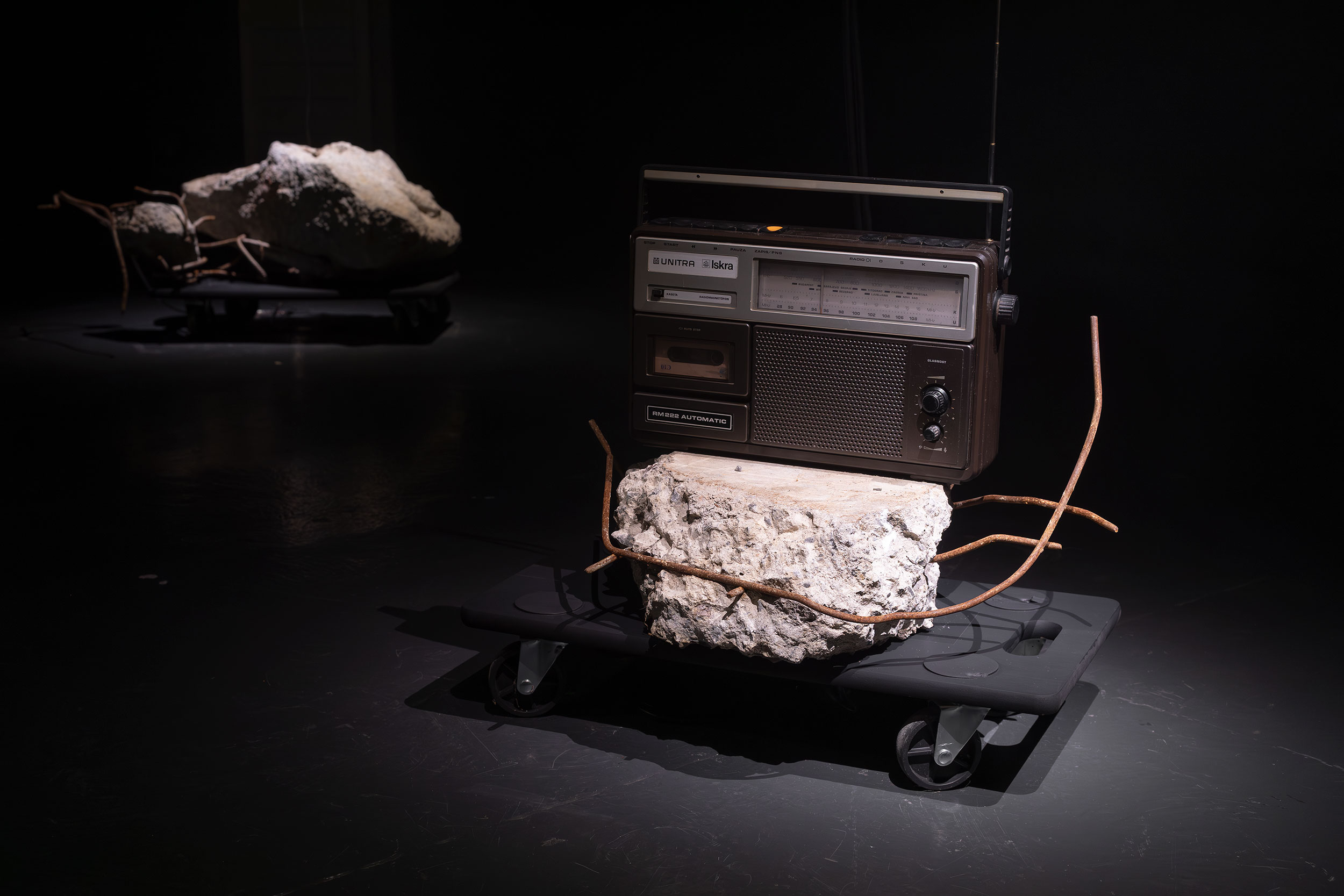
SHOW 1104: “THE GAME,” BY D A CALF (RADIO ONE 91FM, NZ)


The Game
takes its name from the attempts made by asylum-seekers to reach the EU via the overland border between Bosnia and Croatia. Located on the so-called Western Balkan migrant route—and only 10 kilometres from the border—Bihać has for the last 15 years been used as a point from which to attempt ‘the game’. Visible from the nearby monument on Garavice Hill is the local cemetery which contains a small, unkempt plot of graves of many who did not succeed—either drowning in the Una river after jumping off the trainline which snakes along beside it, encountering bears or unexploded land mines from the 90’s wars, or as a result of injuries sustained by the brutal push-backs administered by the Croatian border police. The monument, symbolising twelve weeping mothers looking out over their fallen children from the National War of Liberation (WWII), now takes on new meaning.


Additionally, the title references the local football stadium which at the height of the migrant crisis was used as a makeshift refuge for asylum-seekers. In contrast to the rising authoritarianism in Europe at present which manifests as increasingly harsh immigration policies, Bihać was the first region liberated from Nazi-allied forces in WWII. It was here that the founding principles of Yugoslavia, including its anti-colonial engagement with the global south were first fleshed out, guided by the Partisan call-to-arms ‘Smrt fašizmu, sloboda narodu’ (Death to fascism, freedom to the people).


The composition unfolds over nine thematic chapters (five of which feature in this excerpt), each focusing on one part of the constellational matrix of sites related to Garavice. The composition progresses through abandoned spaces used as makeshift asylum-seeker accommodation, game day at the local football stadium, the fields around Garavice, a border crossing, and archives related to the site, concluding at the point at which a group of asylum-seekers prepare to make a covert, nighttime border crossing. Interludes highlight the geological settings of these locations, while at other points field notes appear in the form of voice over, ruminating on the listening process.


The Game was first exhibited as a 60-minute, 22-channel sound installation incorporating geological and found objects activated by exciters and reclaimed speaker components, in Naarm/Melbourne in February 2026.

//

Bio
D A Calf is a Naarm/Melbourne-based sound and installation artist and researcher, working predominantly with sound, text and photography to explore the remnants and dormant possibilities of failed modernisms. Through field work and archival research his practice contends with archives—impossible, hidden, contested, and otherwise—of place.

www.dacalf.com

www.instagram.com/d_a_calf

//

Show 1103 : “Learning AI How To Dream” by Sebastian Dingens (Radio Campus Bruxelles)

Dreaming is an essential activity in processing experiences and witnessed events. It helps us construct a sense of identity, reality and can (partly) help to process traumatic experiences.

Since AI is constantly confronted with the most violent content on the internet, the Sonic Research Kitchen thinks it is very important that we learn this new technology how to dream. How else can we expect it to process all the violence it encounters on the internet?

If we don’t act now, we’d better reserve the poor thing a spot on the waiting list for a decent psychotherapist.

This is our humble contribution in trying to learn AI to dream. With many thanks to the contributors who preferred to stay anonymous.

Yours truly,
Sebastian Dingens,
for the Sonic Research Kitchen.

About Sebastian Dingens

Sebastian Dingens plays around, and calls it research. He lets his mind drift and calls it improvisation. He makes drawings and calls them compositions. He turns knobs and calls it synthesis. He fiddles with recorded sounds and calls it radiophonic. But he is very serious about all of these things.

AI says that he works at the intersection of experimental music, listening practices, radio and sonic research.

He is fascinated by processes of geological erosion, processes of forgetting and the emergence of memories of never-lived experiences.

The truth, in the end, is one’s own perception of reality.

_________________

cardboard cartoon figures of board surfers on waves of distant ice ages publicity for pubic hair and wrinkled bellies
anorexic skeletons disguised as bones of dinosaurs
fascinating drawings of young children,

curiously smiling with white teeth of disillusion

In a state of introvert depression rage I go to war,
I go to fight my own anger
with the violence of my own blood
on the brown battlefield under a dessert of black clouds

I am seeing myself standing there
but I am looking inward with closed eyes
fatigued by useless attempts to stay human in a hopelessly sick world

________________________________

there’s an impenetrable forest,
a forest inside myself
and inside this forest, there’s a clearing. I am standing there,
in the middle of the clearing
of the forest
inside of myself
there’s no animals moving about.. except for insects
small little insects
crawling around
with the speed of light
….
segmented legs
weird flies
…
a thousand faceted eyes
observe me
I feel their gaze piercing
my own
harnass
….

through bark and bush
there’s only a slow peculation of light
a glimmering reflection
of what used to be hope
seeps through the leaveless branches of berches pale bodied
their skinns inscribed with badly healed wounds as if this groove remembers
a wound I have not yet spoken
…

But if we change perspective ….

I am sitting in front of the open window my legs are a curtain
through the open window
I see a field of refined flowers wheeping, still in the wind

there’s a lot of berchtrees.
my skinn is waving
it is a waving curtain
my skinn is a curtain, waving in the wind ….

the waving enlightens in me a burning desire
the waving enlightens in me an inseasable desire …

and through the open window I see
…

cardboard cartoon figures of board surfers on waves of distant ice ages publicity for pubic hair and wrinkled bellies
anorexic skeletons disguised as bones of dinosaurs
fascinating drawings of young children,

curiously smiling with white teeth of disillusion

In a state of introvert depression rage I go to war,
I go to fight my own anger
with the violence of my own blood
on the brown battlefield under a dessert of black clouds

I am seeing myself standing there
but I am looking inward with closed eyes
fatigued by useless attempts to stay human in a hopelessly sick world

– – –
Radia show curated by Carine Demange for Radio Campus Bruxelles.