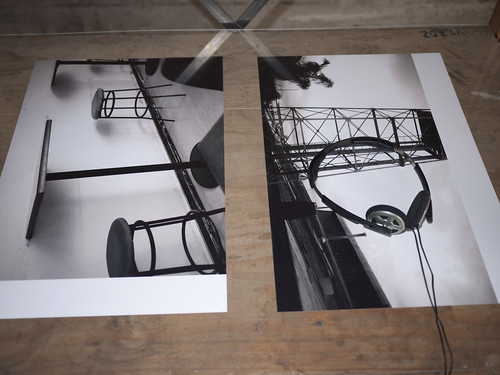
David Clegg is a contemporary artist based in New Plymouth, New Zealand. ‘the miserable idea of measurement (refrain)’ is a radiophonic reworking of audio from an installation of the same name, commissioned by Artspace, a contemporary art platform based in Auckland. Sourced from raw audio files gathered while walking the arcades, streets and parks of the gallery’s immediately surrounding urbanscape (as the artist writes, a tracing of spatial co-ordinates “from Meyers Park, St Kevin’s Arcade and the short walk on Karangahape Road and Pitt Street to Beresford Square”), Clegg’s aural psychogeographic sketchbook is left deliberately partial, wary of totalities, its ear open to the street.
In previous works such as The Imaginary Museum and Archivedestruct, Clegg has layered acousmatic soundscapes back into environments, with the layering nevertheless remaining inconclusive, full of gaps, aware of its own immediacy, the tension between creating meticulously categorised archives that are never set, but re-shuffled and modified over time, being an essential part of such works. Radio, with its indeterminate listenership and distributed networks, is an appropriate vehicle for the extension of these ideas, and this radiophonic edit, without relation to the images also present at the Artspace exhibition, structurally underlines the de-narrativising of sound as it is heard in the contemporary urbanscape – fragmented, twisted, free-floating from its signifiers, yet remaining locally teritorialised, a ‘refrain’, in the Deleuzian sense of the word.
A sound-library of fragments designed to be shuffled, ‘the miserable idea of measurement (refrain)’ presents an imaginative landscape which in formal as well as material terms is digital, non linear, while playing with the linearity of radio as a medium, and suggesting its existence as one fragment of a wider sound field of the contemporary city. While having some relation to early radiophonic Musique Concrete, such as ‘Wochenende’, Walter Ruttman’s c.1930 sound portrait of Berlin, Clegg’s work sketches a temporal/durational drive that suggests the formal fragmentation of the Modernist city and its utopian technologies and narratives – in this piece, the meaning is user-driven, and it is our task to stitch a narrative together. Clegg’s use of home made binaural microphones inserted in his ears to record the fragments suggests a phenomenological reflection on the recording process and creates an embodied feedback loop of listening, reminding us that walking in the city is the ‘static between stations’ of everyday life. Commercial music bleeds from radios, combining with the sonic crush and clatter of the cityscape, and we hear the drone of cicadas, juxtaposed with voices that are non-communicative, declaring to no-one, at once banal and frenetic. Nevertheless, the standardisation of sonic material as a measured quantity cuts everything listenable into precise blocks of time. The artist further underscores this constellation of audible segments as non-linear, and non-narrative by his use of the dead silence of digital media, inserting short, equally standardised silences between sound files. The dropping away of audio becomes a shock of absence : in effect, playing with the radiophonic no-go of ‘dead air’
As Clegg himself writes : “i wanted to juxtapose the porosity and interconnectedness of these neighbourhood spaces with the very dislocated and enclosed room above Artspace, and to question the possibility of establishing/re-establishing a connection between the two in an other than physical way, as some sort of voice or signal/ transmission, between here and there, so the recordings are mostly focused on the different types of voice or signal of a location (in the way that a bird call, or radio broadcast establishes its own territory), as well as those calls and signals that are also entering a location from the outside within the sampled passages of radio and the local ambient sounds, as a series of overlapping refrains and superimposed voices, calls and signals.
what if any new locations are being constructed / reconstructed by the listener, the headphone wearing passer-by? certainly any created location is a highly contingent one, producing itself moment-to-moment, impossible to be returned to (maybe in part if its being recorded?). i’ve become very interested in the territorially-based nature of transmitted sounds and signals, in terms of their reception, as they sometimes go in and out of phase, where interference or the loss of signal can be misunderstood as the right signal, and the extent to which the headphone wearer is in a sense continuously changing and constructing new territories of their own.”
with many thanks to the Creative New Zealand Media Arts fund for supporting this contribution to season #25
read more about ‘The Miserable Idea of Measurement’ on Artspace’s website, here : http://www.artspace.org.nz/exhibitions/2011/davidclegg.asp

 On January 17, 2011, CFRC presents a day-long program of Art On Air. As part of this broadcast CFRC hosted the Art’s Birthday Radio Cabaret live and direct from The Artel, a local artist-run-living space. The following is an excerpt from that live broadcast. Three unique performances by local Kingston audio artists. The first is a performance by SouB?; Kingston’s only interventionist, improvisation, pop-culture riffing, avant-music group. Following that, Decomposing Pianos performs an evocative piece. And finally, Christine Dewancker and Emre Amasyali, offer a found-sound collaboration