Show 374: radio d’oiseaux (kokako variations), by radio cegeste

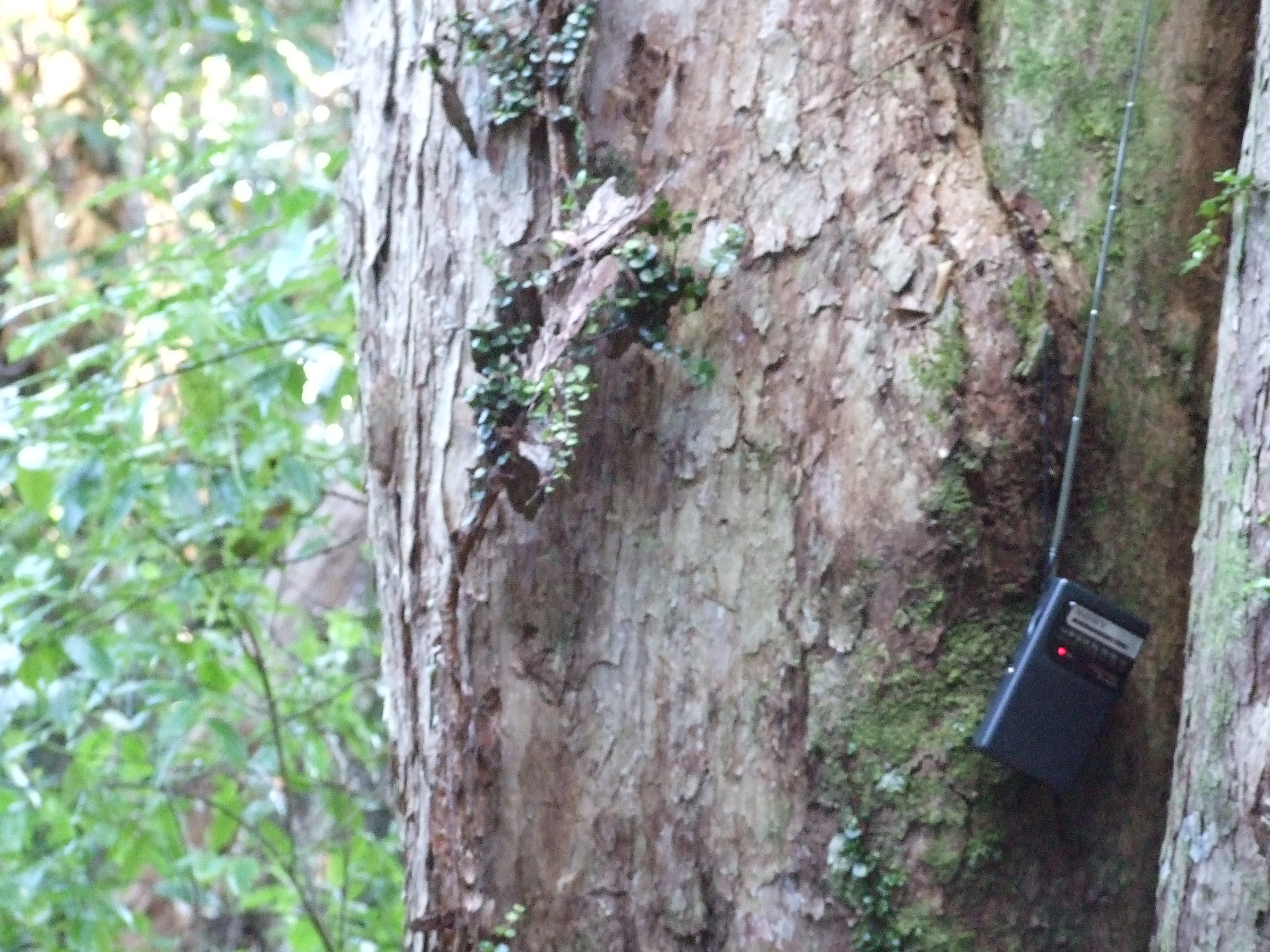
Small, distributed in trees, in hollow logs and on the ground, a flock of radio receivers inhabits a forest area near a large native Rata tree on Kapiti, an island off the coast of the lower North Island of Aotearoa/New Zealand. Slowly, the radios enter the soundscape of the surrounding biosphere, chime in with birdsong captured in field recordings, gathered in the same area on previous days, making audible the signal from a small-radius mini FM transmitter. Down the mountain, a young male Kokako has been calling for the last three months, unsuccessfully trying to attract a mate. The main thing he has been able to attract are the attentions of other, more common endemic forest birds, Tui and Bellbirds, who, being skilled mimics, have started to imitate his calls. Perhaps in response to such unwanted attentions, he has not been heard for the past week, but the radio remembers him, playing back his song in an evocation of both the long history of human vocalisation of birds in this place, and the birds’ own complex mimicry of each other.

Rarely heard but even more rarely seen in the wild, the Kokako, a shy inhabitant of deep forest, and one of New Zealand’s most endangered birds, whose calls have been described variously as “flute-like, organ-like, bell like, sweet, plaintive, haunting and ventriloquial”, has lived on this island since 1991, when thirty three birds were transferred from three remnant populations elsewhere in the North Island. These populations, artificially lodged together into a new environment, yet all sourced from different localities and having their own dialects, originally didn’t recognise each other as the same species, and so breeding was, understandably, unsuccessful. In the ensuing decades, it seems, the development of a ‘Kapiti dialect’ has emerged on the island, and the birds have begun to converse, and to breed, and become tentatively established locally. The South Island subspecies of the Kokako has been declared extinct, and until recently the North Island variant was declining toward the same fate, but in the last few years, due to such placement on offshore predator-free islands, the birds have become one of the recent success stories of New Zealand conservation species management.

A document of a single take performance with no human listeners, beginning and ending as an unadulterated recording of the sounds of the locale in which it was enacted, this mini FM transmission subtly weaves various other recordings from the same location at other times of day into the extant soundscape, a collected sound library begun with the very early morning chorus and progressing toward midday, the time when the piece was transmitted. Shifting sound tonalities are heard, these are entirely due to the aforementioned ‘flock’ of radios and how they are positioned in relation to the stereo microphones used to record the piece. Static is heard when the radios leave this radius of transmission, the territory of the signal marking its place in the forest with song, shards of noise signifying its breach, echoing its placement on an island in a biosecure, highly managed environment forever on the lookout for tears in the fabric, and also birdsong itself as a highly territorialised marker of location and identity. The chiming dawn chorus of bellbirds at the piece’s apex thins out to eventually become a duet of call and response in real time between a live Kokako, attracted by the transmission, and the radios switching off and on as they transmit the song of the same bird, a disjunctive ventriloquistic mediated discourse, not without its own poetry, bird and radio calling to each other for an extended moment over the thick native tree wooded valley.

radio d’oiseaux (kokako variations), through its fabric of forgetting and remembering, of dialect and localisation, ponders the hope for an environmentally aware media that doesn’t approach environment from the perspective of the covetous collector or become a mere one-way conduit for the human ear, but leaves the sounds where they are, taking the advice of the New Zealand environmental care code: Toitu te whenua (leave the land undisturbed), at the same time risking an indulgence of the radio’s secret fantasies of interspecies communication, of not only being a sender but also a receiver, of joining in with the chorus and listening to its localised specificity, of being part of the living soundscape rather than merely part of its museum.

—–

this live transmission was made into the bush at Rangatira on Kapiti Island, beginning at 12:20pm on Thursday the 21st May 2012.

Radio Cegeste 104.5 FM is a mini FM radio station hosted as a platform for radio art by Sally Ann McIntyre. Its projects and programmes cohere around a loose set of circumstances and proclivities, including site-specificity, nomadism, the collection of sound libraries, phonography, museology, memory, the haunted materiality of absent presence, old buildings and other historic sites, psychogeography, the performative fragility of small-scale transmission, bird migration and electromagnetism, the complex idea of ‘dead air’, the recorded and transmitted history of birdsong (sometimes also as a sonification of a New Zealand nationalism), and the possibility of an ecology of the radio that doesn’t represent unstable systems as functioning in eternal homeostasis. Her current residency on Kapiti Island, during which she is conducting research into the soundscape and investigating the potential for radio art as a form of fieldwork, is sponsored by the New Zealand Department of Conservation and Creative New Zealand, in association with the Kaitiaki o Kapiti Trust.

Show 373: THE TIME MACHINE – Ufos by Plastique de Rêve

Between live mix, sound collage and scientific experiment, “The Time Machine” explores the many dimensions of past and present day electronic dance music, quantum-jumping the barriers within the genre, blurring the lines between past, present and future, with its search-lights focused on the rare and unusual.

The test-pilot is Daze Dasen aka Plastique de Rêve, a swiss deejay and producer with releases on labels such as Gigolo, Turbo, DFA, Supersoul Recordings, Mental Groove or Space Factory Disques. Originally from Geneva but now a long-time Berlin resident, Plastique De Rêve’s fascination for electronic sounds goes back to his childhood in the 70s, and he has studied, produced and collected electronic music since 1984 up to this day.

http://listn.to/PlastiqueDeReve

Show 371: TIME BENDING CLOCK RADIO: WINDTIME

radia season 28 – show #371 (radio x) – TIME BENDING CLOCK RADIO: WINDTIME
– playing from may 7 to may 13, 2012 –

WINDTIME
by TIME BENDING CLOCK RADIO

“Betrachten Sie einmal ein ganz populäres Diagramm, eine Wetterkarte. Die Linie, die ich mit meinem Finger nachziehe, zeigt die Bewegung des Barometers. […] Das Quecksilber hat doch offenbar die Linie in keiner der landläufigen Richtungen des Raumes gezogen? Aber ganz zweifellos zog es eine Linie, und diese Linie hat sich, so müssen wir schliessen, längs der Zeitdimensionen bewegt.”*

clocking windtime. not to draw a line along the dimensions of time. but to tear a hole into the latter.
listening closely to the ticks and tacks of winds and weathers, thunders and lightnings of bells and chimes, the whispers of clocks. timelines dissolving in the rain.

* quot. Egon Friedell: Die Rückkehr der Zeitmaschine. Zürich: Diogenes, 1974, pp. 13/14. [roughly transl.: “Just take a look at a really popular diagram, a weather map. The line I am following with my finger demonstrates the barometer’s movement. […] Obviously, the quicksilver has not drawn a line according to the general dimensions of space. Yet it has drawn a line – and thus, we have to conclude, this line has moved along the dimensions of time.”]

WINDTIME is a production of TIME BENDING CLOCK RADIO.
TIME BENDING CLOCK RADIO is radio on time.
since summer 2010, TIME BENDING CLOCK RADIO is one of the active mechanisms of the TIME BENDING CLOCK, a research project and tool looking at alternate theories and practices of measuring time, operating at the intersections of art, media, cultural history and the history of science.
find out more about the TIME BENDING CLOCK by visiting the TIME BENDING CLOCK WORK.

Like TIME BENDING CLOCK, TIME BENDING CLOCK RADIO is part of the TIME INVENTORS’ KABINET (TIK).

TIME INVENTORS’ KABINET (TIK)
is a collaborative artistic research project at the intersections of ecology, art, and media,
taking an ecological approach to observing patterns in time and time control systems.
find out more about TIK at www.timeinventorskabinet.org

credits:
this TIME BENDING CLOCK RADIO production is based on fieldrecordings by the following artist and artists and sound collectors who generously released their pieces on www.freesound.org unter a creative commons license – in detail:
a severe thunderstorm by martin lightning (including also storms from rhumphries); wind by black boe; wind chimes and creaking wood by smusounddesign; wind chimes by freed; water bubbles by suonho elements; clockworks by klangbeeld; a russian telegraph by microscopia; and a cuckoo clock by morgantj.
in addition to that, miss.gunst wishes to thank the following artists and sound collectors for additional material that has been used for the post-production of the show: bent grandfather’s clock based on the sound of a grandfather’s clock by digifish; wind created by ERH from freesound; and another time the cuckoo clock by morgantj. find out more about freesound at www.freesound.org – great many thanks!
moreover, very special thx to tk!

metadata:
WINDTIME
by TIME BENDING CLOCK radio
radia production: miss.gunst [TBC radio + GUNST + radiator x]
production date: mai 2012
station: radio x, frankfurt am main (germany)
length: 28 min.
licence: cc-by-nc-sa TBC radio
www.radiox.de – www.gunst.info – www.under-construction.cc/tbcw

additional info:
includes radia jingles (in/out), station and program info/intro (english)

links:
radio x & radiator x: www.radiox.dewww.radiox.de/radiator-x
GUNSTradio & TBC radio: www.gunst.info
TIME BENDING CLOCK WORK: www.under-construction.cc/tbcw
TIME INVENTOR’S KABINET: www.timeinventorskabinet.org

pics:
verena kuni (cc-by-nc-sa)

Show 370: what you doin’ tapin (radia edit) by Dani Gal & Achim Lengerer

British Artist William Furlong began a project of mapping the territory of contemporary art in a series of cassette editions. The Audio Arts project is a massive archive of intervies wirg artists ranging from Joseph Beuys to Tracey Emin, but also contains documents of world exibitions, symposia, festivals and many original acoustic works by artists. Furlong finds rgar his way of working – using sounds and voice as materials – is a sculptural and creative process. It arose from his intimate association with the recorded voice.
In 2007 artists Achim Lengerer and Dani Gal visited Furlong in his Audio Arts studio and recorded this sound piece as a reference to his body of work.

This Radia show is a special edit of Lengerer and Gal’s piece realized in 2007 for their project VOICEOVERHEAD. “Voiceoverhead” dealt with performative aspects of speech, sound documents and archived spoken language.

Any resemblance with Radia show 228 by radio x is accidental but undeniable.

Show 369: digging radio by orange 94.0

DIGGING RADIO

Yet another annoying piece of radio art?

In the beginning there was the paraphrase. Starting from the search for radio art events to be reproduced we ended up looking into landmarks of radio history in connection with art– hopping from its beginnings to the digital turn.

Listen to a simulation of history and how it is digged out of its holes.

Ironic reenactment of GX Jupitter-Larsens performance in a small bin. The small scoop produces the sound of a shovel.

A radia show by Kristina Fromm, Lale Rodgarkia-Dara, Fiona Steinert

supported by Barbara Kaiser, Karl Schönswetter, Sara Norris, Christine Schörkhuber und Judith Purkarthofer.

Continue reading Show 369: digging radio by orange 94.0

Show 368: voxpop by XL AIR

This XL AIR production consists of a remix radio composition that builds on material used in RITS installations that were created for Bozar Night in November 2011. They both embrace the human voice as a musical instrument.

The first installation was created collectively by the students of the masterclass audio (Tomas Vogels, Simon Vandegracht and Renee Vermeire) and is based on a musical composition  that uses only the vowels of speech.

The other installation is called ‘Vozombrascimento’ and was created by Dieter Van Dam. The Portuguese words ‘voz’ (voice), ‘sombra’ (shadow) and ‘nascimento’ ( birth) form the name of this soundtrack consisting out of manipulated voice traces of a newborn human being.

A cry is the anticipated proof of new life. Not a breath. Not a song. Not a word. A cry. This installation was placed in a big echoing space that suggested a sonic shadow of the primordial human cry by using and manipulating recordings of a child’s s singing in his first year of life.

Show 366: ATC Mix by John Gough

ATC Mix is a compilation of interactions between pilots and air traffic controllers from airports across the globe. The conversations range from controllers directing traffic at Dublin, Rio de Janiero and Barbados Airports to UFO sightings, an air force pilot ejecting from his burning jet and Air Force One taxiing out of a closed Manchester airport.

This show is  about the sounds of the radios used between the planes and the towers as much as the transmitted conversations. The human voices, radio interference and alert tones are used as source material for a series of improvisations using tape and feedback loops, digital effects and synthesis to morph the sounds into rhythmic patters and melodies which morph into an alien soundscape.

This program was inspired by the work of Keith Phelan at http://5p4c3.com/eist/le/shannon and the people who take the time to stream all the traffic over at http://www.liveatc.net/.

This program was created by John Gough at Curious Broadcast.

No souls were injured in the making of this program.

Show 365: Kanal 103: 20 years of freedom!

Last year Kanal 103 celebrated 20 years of its first broadcast. Kanal 103 is important (terrestrial) radio station that determined the underground scene and the open mindedness in Skopje and beyond. Kanal 103 is the only non-commercial radio station in Macedonia with cult following among the audience. Transmitting since 1991, it’s promoting avant-garde music and ideas, and is responsible for the most important cultural transformations in the region. During its existence there were produced lots of jingles, radio pieces and short radio dramas with strong ideological and anti-state edge. In this honor we produced this audio collage as a homage to this past 20 years of independence, surfing through the history of the audio production. Kanal 103 – 20 years of freedom!

“The listener would recognise the programme because nobody else in Skopje plays music from Frank Zappa to post-rock and from Kraftwerk to modern techno.” prof. Rajko Muršič (University of Ljubljana)

“I think the radio station is one of my favouite places in the world, like a small satellite floating in space, beaming out joy from cold labyrinths of madness.” Daniel Potter (The White Funz)

http://www.kanal103.com.mk
http://www.myspace.com/kanal103
http://www.last.fm/user/Kanal103
http://twitter.com/kanal103