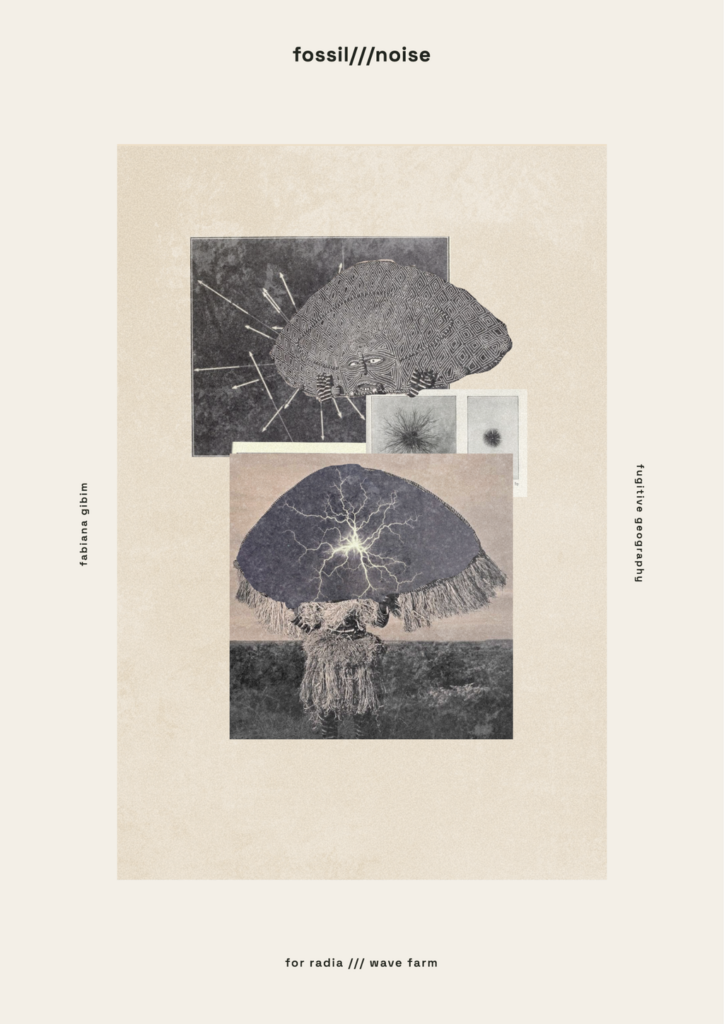
Show 1113: FOSSIL///NOISE by Fabiana Gibim for Wave Farm

An archive on the regulatory sense offers two shapes to live in: the grid, discrete, indexed, metric, the space of the catalogue and the timestamp, where everything has a slot and a slot has everything, or the flow, smooth, continuous, borderless, the space of the algorithm that sorts by resemblance instead of by rule. The flow looks like an escape from the grid. It works instead as the grid’s next form. Control doesn’t need walls once it can modulate a stream. Smoothness rarely means freedom: it works as surveillance without edges. A technofossil, though, doesn’t live in either shape. It lives in the escape of a different dimension from them, a fugitive geography. Between any two points in an archive there are always more points, mysterious, semiopen parts that are somehow both separable and inseparable from their neighbors, a texture that is neither cleanly cut nor cleanly continuous. This is a mereotopology. A technofossil can then be a fragment that stays a fragment no matter which classification tries to absorb it. It works less like debris than like a lure. A technofossil behaves the way a living fossil like the Arctic lamprey hunts, offering part of itself as bait, a tongue that wiggles like prey, close enough to something known to be pulled in and named, then slipping the catch just as recognition closes over it, a catastrophe of recognition that keeps recurring. Fugitiveness works this way too, staying legible only to itself, moving in ways the archive’s capturing apparatus hasn’t learned to follow yet.

What makes this geography fugitive, rather than simply unmapped, is that the archive’s own attempt at closure produces it, from inside its own edges. Any finite set of rules, any index, any algorithm, any catalogue, throws off a remainder it cannot account for, an incompressible residue generated by the very act of trying to make the archive total. A technofossil behaves the same way a transmission behaves once it has outlived the station that sent it, an archive of doom still propagating after the system that made it has closed the file. It persisted, migrated onto substrates nobody built for it, the way certain organisms take a bomb crater or a subculture takes root in the wreckage of a project that already failed, an ecology of distortion. It can also work as an archive of the hypothetical, a wrong prediction still waiting in the record for a chance to act on the present again.

In an attempt to scavenge a technofossil in this mix, nothing is mourned back into coherence. It stays inhabited in its ruined form, activated at the exact pitch of its distortion, an affection for destruction, that distortion is still carrying a charge.

Here, we are interested in the incomputable residue that any act of transmission, capture, or archiving throws off, and in treating that residue as the actual terrain worth mapping. An archive that fully accounts for everything it holds has stopped being strange to itself. Fossil///Noise is built from the technofossils it can’t hold, the fragments left over once the filing is done.

Samples include:

André Damião – Deumaestrutura (from NARVA2) — 2022
Merzboom – un till ed #002 – The Nightmare Continues — 2024
Yuri Bruscky – Trava-Língua nº 3 — 2023
W. Halliday – Arctic Noise (WCS Canada Ice Sounds) — n.d.
W. Halliday – Fish Grunt Sachs — 2015
W. Halliday – Bearded Seal — 2016
God Pussy – Raízes em Transe (from Diáspora: Expressão Ancestral) — 2023
God Pussy – Contos de Sinhá (from Diáspora: Expressão Ancestral) — 2023
Jesse Paul Miller – Sounds of Secret Records — 1995/1998
Martín Rodríguez – Des Cloches À La Solidarité / Une Grande Onde, Entre Temps Perdus (Transmission Ecologies Ep.14) — 2022
Sbjtvo – Isla decepción (title track) — 2020
Budhaditya Chattopadhyay – Sonic Psychogeographies II — 2025
Ajítẹnà – Chuva (from Habitar as coisas) — 2023
Jordan Belson & Stephen Beck – Cycles — 1974
Len Lye (film) / Andrew Pask (soundtrack) – Tusalava — 2008
Takashi Ito – Thunder — 1982
Amy Ireland – Cultivating Darkness — n.d.
Class Divide (dir. Simon James) – Neolithic Cannibals Soundscape — 2024
Reza Negarestani – On the Practical Necessity of Having Demons (Session 4) — n.d.
Sadie Plant – Where to with Cyberfeminism (CTM 2014) — 2014

Show 1112: The Sonic Epidermis of Lake Léman by Paul Courlet (Guest Slot)

Radio drama 2026 by Paul Courlet
produced by the International Institute for Research for Radio and Magic

An introduction to the concept of the undulatory epidermis.
This is the story of Jaklos, a young man who, following in the footsteps of his uncle Perdida, embarks on a long journey that will take him to the shores of Lake Léman, where he will make his fortune. In this epic tale, Lake Léman exerts a fascination over him that goes far beyond mere aesthetic admiration.
Very quickly, the lake will become an essential element of this tragedy, representing far more than a mere detail of the landscape, as it exerts a profound influence on his psyche. Like an oracle, it will reveal itself to be an evil creature, and Jaklos will not be its only victim.

A radia guest slot from L’Institut International de Recherche sur la Radio et la Magie
https://iirrm.ch/

Epiderme sonore du Léman

Œuvre radiophonique 2026
Par Paul Courlet produit par l’Institut International de Recherche sur la Radio et la Magie

Introduction à la notion d’épiderme ondulatoire.
C’est l’histoire de Jaklos, un jeune homme qui, suivant les traces de son Oncle Perdida, entamera un long voyage qui le conduira au bord du lac Léman où il fera fortune. Dans cette épopée, le lac Léman exerce sur lui une forme de fascination qui va beaucoup plus loin que la simple admiration esthétique.
Très vite le lac va devenir un élément essentiel de cette tragédie, et représenter bien plus qu’un simple détail du paysage, agissant sur sa psyché. À la manière d’un oracle, il se révélera être une créature maléfique et Jaklos n’en sera pas la seule victime.

Show 1111: Schisma Gulf, Isogloss & Lament for the Old Clock by Harvey Young (Resonance)

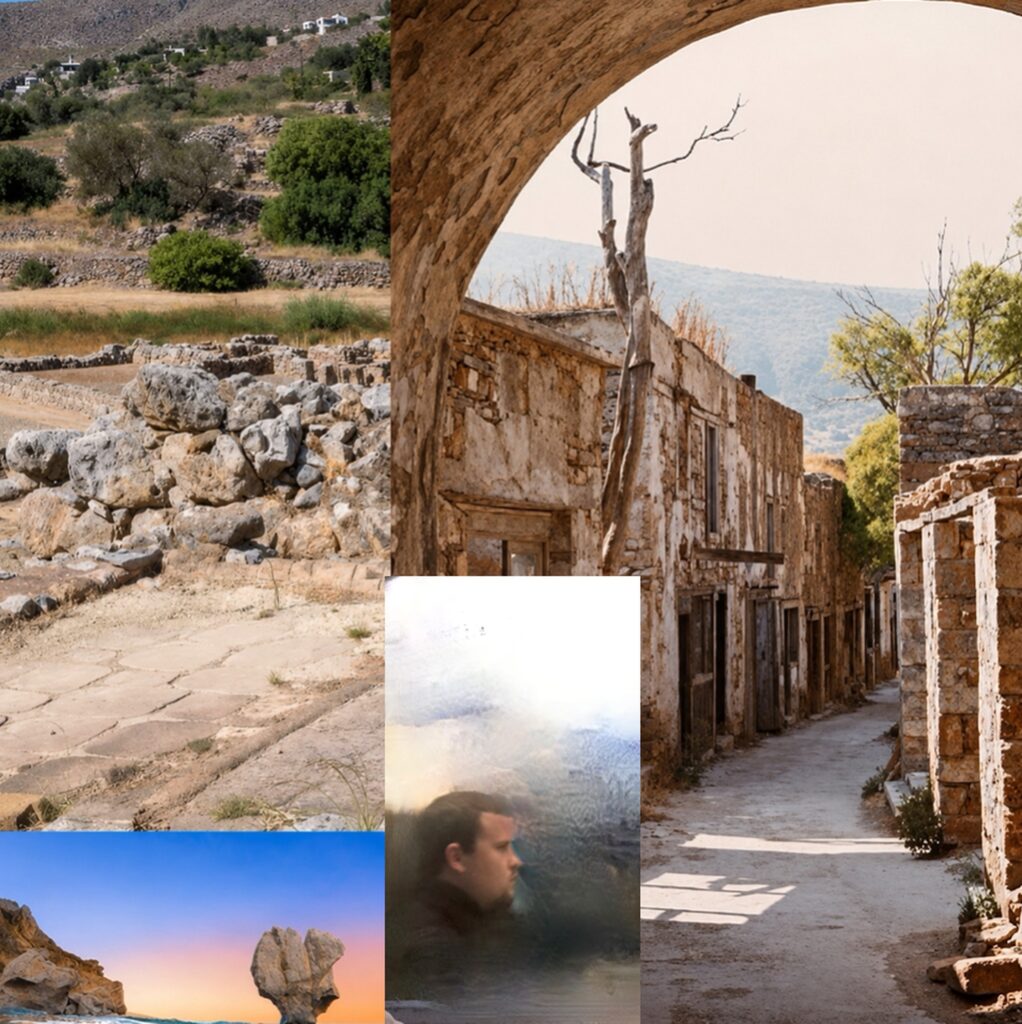
Three works for radio by composer and sound artist Harvey Young. First, Schisma Gulf: “In September 2024, I traced ethnographer Maurice Born’s journey to the island of Spinalonga, a former leper colony in the Gulf of Elounda, Crete. Buoyed by foggy iterations of Saint Panteleimon and mid-50s atrium film nights, I set about sonifying his initial investigations, from his arrival in a blow-up dinghy to the final survey of the admission and disinfection buildings.” Secondly, Isolgoss, a composition for five loudspeakers: “I’d been reading linguist James Burridge’s work on dialectal formation and spread. He applies surface tension dynamics to the interaction between language groupings. I thought it would be tasteful to interpret these mechanics using extended vocal techniques (trills, ululation, phonetically varied vowel shapes) and granular synthesis to capture the kineticism that underpins linguistic evolution. Mixed into spatial audio at Piel View House, Cumbria.” Thirdly, Lament for the Old Clock which tells the story of an 18th-century agricultural worker plunged into the vicious new frontier of industrial capitalism who must leave his simple agrarian existence behind and submit to the callous and dehumanising demands of the factory floor. The piece documents the change in temporality from the feudal notion of cyclical, reverential time to the concept of future-oriented progress that defined the beginning of the industrial revolution. Through extended vocal techniques, found instruments and granulation, Lament for the Old Clock explores this transient yet profound period of temporal and spiritual upheaval.

Harvey composer-in-residence at the Abeceda Institute, Ljubljana (2025), and has presented electroacoustic installations in Europe and North America. His experimental opera and poetry works have been commissioned by Resonance Extra and Whitechapel Gallery, and he writes at presents Pitch-Complex on Radio Worm. He has contributed research to Oscar-nominated producer Jaimie D’Cruz’s Acme Films, and assisted John Akomfrah on the video installation In the Hour of the Dog for the Baltimore Museum of Art.

show 1110: Freeze, Asian Archive by Avita Maheen (Radio Worm)

Freeze, Asian Archive documents the immigrant neighbourhood stretching from West Kruisplein to Mathenesserplein in Rotterdam. Starting from the East Asian shops and restaurants often known as Rotterdam’s Chinatown, this 2.3 km street extends into a mix of Asian and other non-European grocery stores, restaurants, small businesses, and third spaces, representing communities from East, South, Southeast, and West Asia, as well as South America, Africa, and former Dutch colonies. Immigrants often carry with them an image of home from the time they left. As they recreate these spaces abroad, they become time capsules where the past is preserved through visually through the interiors and sonically through the music playing inside. In November 2025, I walked this street and recorded the music playing in different Asian and Non-European grocery stores and restaurants. This soundwalk is a homage to the moments of time that remain frozen through migration and displacement.
Bio:
Avita Maheen (aka two4.41139) is a Bangladeshi sound, performance, media artist, writer, and curator based in Rotterdam, Netherlands. Her practice is centered on sound, memory and she authored the framework titled the embryonic desire, with autoethnographic research on personal and urban influences of globalization in post-millenium Bangladeshi urban music culture. Maheen is the founder of Kalponik Rekha and Chaya Chobi, platforms for South Asian experimental sound art and ambient cinema, and is a guest Adjunct Faculty at Pathshala South Asian Media Institute.